
Another bike outing was at the Oil Creek State Park, SE of Erie, with Oil City to the south of it and Titusville to the north. A 10 mile paved bike path runs the length, with interpretive signs along the way. These signs tell of Oil Creek history - the world's first successful commercial oil well (in 1859 by the Seneca Oil Company!), the ups and downs of oil discoveries, great gushers and riches, fires, and wells run dry. The land is also testament to the regenerative powers of nature. Riding along this gorgeous trail, surrounded by lush green growth and clear, pretty waters, it's hard to believe that 150 years ago the land was ravaged by the oil, and then the lumber, industries. Leaving bare naked land, and oily water. Sounds appealing, eh? But then again, where would we be without those discoveries and those developments? And how else do we learn to do things differently but to go about it the wrong way first?! We struggle with the tools and knowledge we have at any given time. And hopefully learn as we go and find better ways. Anyways, apparently, after the oil petered out and the forests were decimated, FDR's Civilian Conservation Corps came riding in upon efforts to survive the Great Depression and replanted and reclaimed the land. And now it is largely unrecognizable as the center of so much destructive (and productive also!) activity.
 It is also a bit of a refuge on warmer days, as much of the trail is under tree cover and thus shaded. Popular with all walks or wheels of life, people bike it, walk it, and rollerblade it.
 An example of the regeneration this area has undergone - the sign mentions all the buildings and businesses that existed in this one spot back in the day. Gone to the point of invisibility - all I could see were trees and plants.
 At first, much of the oil found upstream was floated downstream by barges such as this. But generally the creek's water level was low. So pond "freshets" were utilized. This meant that dams were created to hold back water until enough water had accumulated to release and thus create man-made surges for the barges to ride downstream. But this was akin to surfing with very ungainly "surfboards!" Timing things right to ride the various waves was apparently pretty tricky and occasionally ended up in catastrophe for many. But more than men suffered with the barge transport. Some photos showed barges pulled by horses in the creek - apparently the poor horses were used to drag the barges back upstream afterwards (and this with a heavy casualty on horse life, as they were made to work even in high water and icy conditions, and brutally beaten - horses and mules were cheap and expendible. I can't endorse that part!!!).
 The Petroleum Centre at Oil Creek (a mini-museum).
 Just imagine this scene so long ago, bare and brown... More evidence of how Time (and helpful efforts) heals.
 Once-again beautiful Oil Creek.
 Path partakers.
 Wild bee balm.
 Sunlight plays and exaggerates on the leafy greens.
 More bee balm.


 Passenger.


 Shadows can be very weird things - but esp. on a semi-recumbent bike!


 13.1, and I'm done.


 But the highlight of this beautiful hike? On my way out, I stopped to listen to a faint sound of movement in the ferns and plants on one side of the trail. Intrigued and always ready for a good critter sighting, I moved in. However, when, after a few brief and limited glimpses, my best guess turned into porcupines, I grew more cautious - quite a bit more cautious! I didn't know what all it would take to prompt them to throw their quills my way! After a bit, I could tell there were two - evidently a parent and a baby. The parent moved away, out of my sight and well into the thickets of bushes. But the baby held still, probably hoping it was hidden and camouflaged well enough. And at first, it was too hidden to really see well, but I persisted, waiting and slowly moving closer whenever the baby would move enough to make a little noise. Finally the baby crept into a more open spot, and I was able to at least get a couple point & shoot shots. Too cute!!
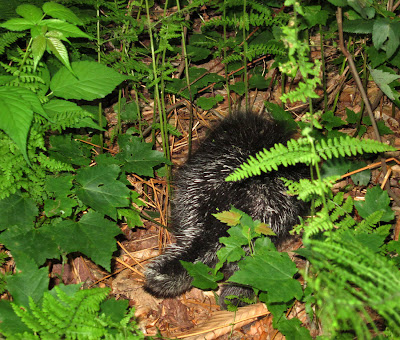 The end. Well, the baby's rear end, that is...


